Temple of Heaven Beijing Travel Guide History Tips 2026
Quick Overview of the Temple of Heaven Beijing
Planning your first trip to Beijing and wondering if the Temple of Heaven Beijing is really worth your time? It is — and for very different reasons than the Forbidden City or the Great Wall.
The Temple of Heaven (Tiantan) is a vast imperial altar complex where Ming and Qing emperors once came to pray for good harvests and the well-being of the empire. It’s not a single “temple” in the Western sense, but a carefully designed landscape of halls, altars, ancient cypress groves, and open spaces built around one idea: connecting heaven and earth. That’s why it matters — it’s the purest expression of ancient Chinese cosmology and state power you can still walk through today.
You’ll find the Temple of Heaven in southeast central Beijing, just below the historic Qianmen area and a short ride from Tiananmen Square. The park is huge — about 270 hectares (almost 670 acres) — which means you’re not just shuffling through a crowded courtyard. You’re moving through wide ceremonial axes, quiet tree-lined paths, and local life zones where Beijingers actually hang out every day.
Why do so many travelers search for “Temple of Heaven Beijing” before they go?
- They want to know how it compares to the Forbidden City and whether it deserves a spot in a tight itinerary.
- They’re curious about must-see spots like the Hall of Prayer for Good Harvests, the Circular Mound Altar, and the Echo Wall.
- They’ve heard about the morning tai chi, dancing, and music inside Tiantan Park and don’t want to miss that local vibe.
- They need clear info on tickets, opening hours, best photo times, and how much walking is involved.
From my side, I treat the Temple of Heaven as a core stop in any Beijing travel guide I create. It gives you a powerful mix of history, design, and real local life in one place — and that’s exactly what most U.S. travelers are looking for when they search for Temple of Heaven Beijing.
Temple of Heaven History and Meaning
Ming Dynasty beginnings under Emperor Yongle
The Temple of Heaven (Tiantan) was built in the early 1400s under Emperor Yongle of the Ming Dynasty – the same emperor who built the Forbidden City. He moved the capital to Beijing and needed a sacred space where the emperor, seen as the “Son of Heaven,” could communicate directly with heaven on behalf of the empire. That’s why this isn’t a “temple” in the usual religious sense; it’s a state-level ritual site designed for one purpose: imperial ceremonies to keep the empire in heaven’s favor.
Imperial sacrifices and prayer rituals
For centuries, Ming and Qing emperors came here mainly in winter to perform the heaven worship ceremony. Key points:
- They fasted and stayed in a fasting palace nearby before rituals.
- At the Circular Mound Altar, they offered sacrifices (once including animals, later symbolic offerings) to heaven.
- At the Hall of Prayer for Good Harvests, they prayed for good crops, stable weather, and social order.
These weren’t public events. Ordinary people were kept out. Everything – the timing, the music, the incense, the number of steps and stones – followed a strict ritual code that reflected ancient Chinese cosmology.
Changes in the Qing Dynasty and Republican era
Under the Qing Dynasty, Manchu rulers kept the same system but added their own touches, reinforcing the Temple of Heaven as the core site of imperial legitimacy.
After the fall of the Qing in 1911:
- The last emperor, Puyi, stopped using it for ceremonies.
- The site shifted from an exclusive imperial altar to a public park in the Republican era.
- Some structures were damaged or neglected, then restored as the new Chinese government started to value it as cultural heritage rather than an active ritual space.
UNESCO World Heritage status
In 1998, the Temple of Heaven became a UNESCO World Heritage site. In practice, that means:
- It’s recognized globally for its outstanding architectural and historical value.
- There are tighter rules on restoration, construction, and commercial activities around the site.
- Funding and expertise are directed toward preserving original Ming–Qing materials, colors, and layout.
If you’re planning broader cultural travel in China, it fits well with other heritage-focused trips, such as exploring Confucian sites in Shandong using this Qufu Confucius heritage guide.
Why it matters in ancient Chinese cosmology
The Temple of Heaven is basically a 3D model of how ancient China saw the universe:
- Heaven = round, Earth = square – reflected in round altars and halls on square platforms.
- The emperor stands at the center, acting as the bridge between heaven and earth.
- Alignments on the north–south axis, symbolic numbers (especially 9), and the use of blue, white, and red all express a vision of a cosmic order that the emperor had to maintain.
When you walk through Tiantan Park today, you’re not just in a pretty park in Beijing. You’re walking through the political and spiritual “operating system” that ran imperial China for 500+ years.
Temple of Heaven Architecture and Design
The Temple of Heaven in Beijing is all about precision and symbolism, not random beauty. If you’re used to European churches or American city layouts, this place feels totally different—everything is designed to reflect how ancient Chinese emperors understood the universe.
Circles, Squares, and Colors
The core idea is simple: heaven = circle, earth = square. Once you know that, the whole layout starts to make sense.
- Circular buildings & platforms (like the Hall of Prayer for Good Harvests and the Circular Mound Altar) represent heaven.
- Square bases, courtyards, and walls represent earth, grounding the complex.
- Blue roofs = the color of the sky and heaven.
- Red pillars and walls = imperial power and life.
- Gold details = divine favor and royal authority.
Nothing is decorative “just because.” The number of pillars, steps, and tiles often follows lucky numbers like 9 (considered the most powerful yang number in Chinese culture).
North–South Axis and Feng Shui Layout
The Temple of Heaven is built on a strict north–south axis, a classic Beijing imperial planning rule. But here, the logic is spiritual, not just political.
- The main structures—Circular Mound Altar → Imperial Vault of Heaven → Hall of Prayer for Good Harvests—line up like beads on a straight line.
- The southern part is slightly higher and more open, emphasizing the connection with the sky.
- The whole complex follows feng shui, using orientation, space, and symmetry to keep harmony between humans, earth, and heaven.
If you’ve done any hiking or nature trips in China, you’ll recognize this harmony-first thinking from how scenic spots like Xishan Forest Park in Beijing are laid out around natural landforms.
Outer Park vs Inner Altar Area
Think of Tiantan Park (Temple of Heaven Park) as two zones:
Outer Park (free-style park area)
- Massive green space with cypress groves, paths, and local morning activities.
- This is where you’ll see people doing tai chi, dancing, playing cards, or singing in groups.
- Great if you like slow travel, people-watching, and photography.
Inner Altar Area (ticketed cultural core)
- This is where the main sites are: Hall of Prayer for Good Harvests, Imperial Vault of Heaven, Circular Mound Altar, Danbi Bridge, etc.
- Layout is formal, symmetrical, and clearly ritual-centered.
When you’re planning your day, mentally separate “park time” (casual walking) from “altar time” (focused sightseeing).
How It Differs from the Forbidden City
A lot of U.S. travelers assume the Temple of Heaven will feel like a smaller Forbidden City. It doesn’t.
- Function
- Forbidden City: living and working space for emperors.
- Temple of Heaven: purely a ritual and sacrifice site—no one lived here.
- Feeling
- Forbidden City: dense, enclosed, heavy red and yellow, tons of halls.
- Temple of Heaven: open, airy, with huge lawns and old trees. It feels like a mix of sacred site and urban park.
- Design Focus
- Forbidden City shows imperial power over people.
- Temple of Heaven shows imperial connection to heaven and cosmic order.
If you like big open views, symbolic design, and a mix of culture plus relaxed park vibes, Temple of Heaven architecture and design will probably hit you harder than you expect.
Main Sites Inside the Temple of Heaven Beijing
When people search “Temple of Heaven Beijing”, these are the spots they actually come for. I’d plan your walk around these key sights so you don’t waste time backtracking.
Hall of Prayer for Good Harvests (Qi Nian Dian)
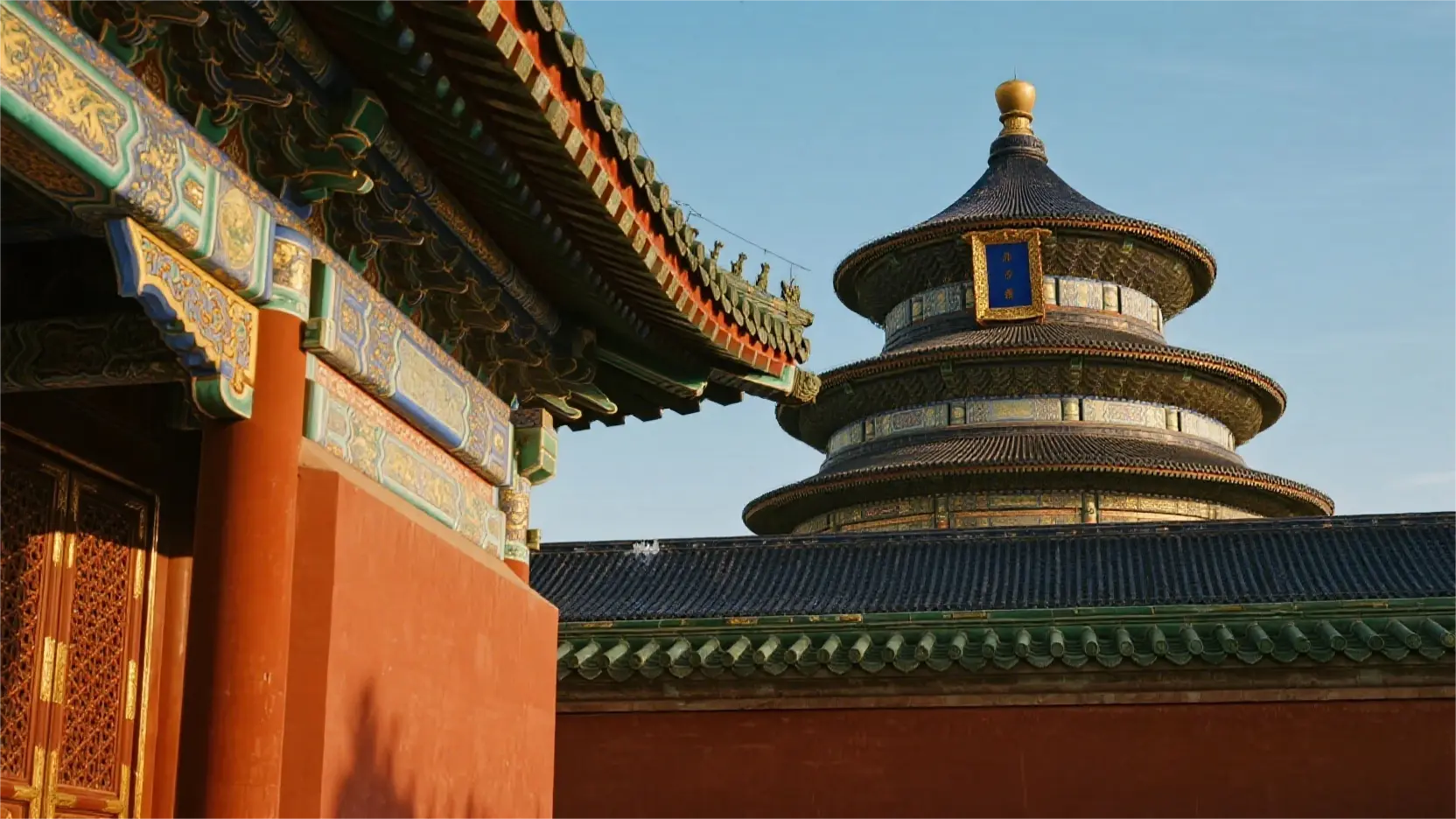
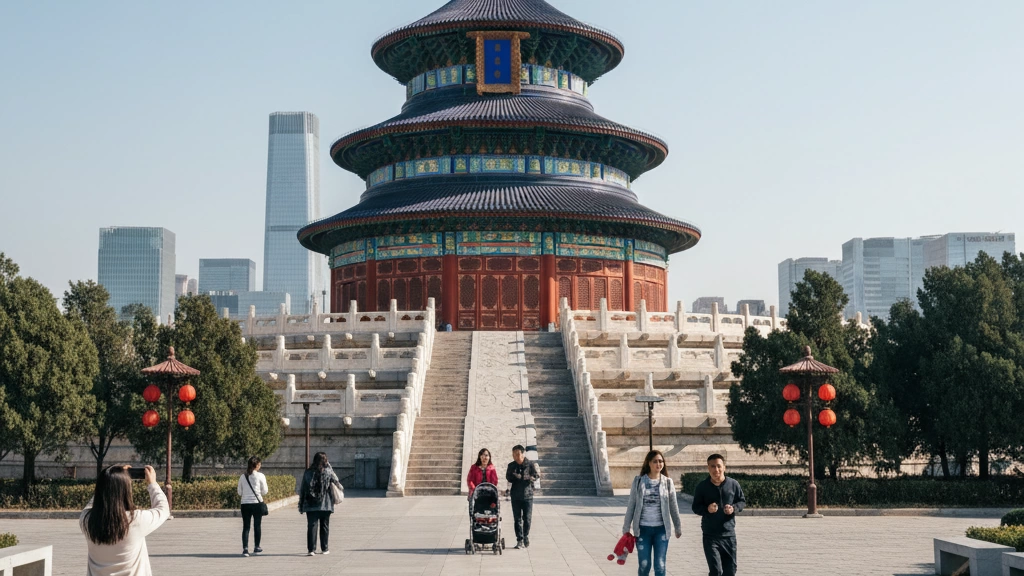
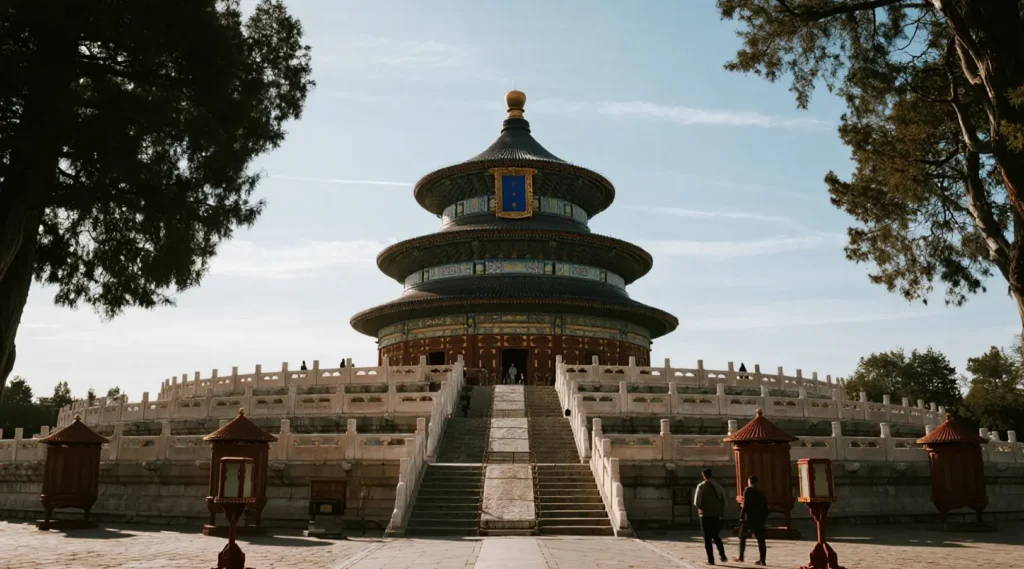
This triple-roofed, blue-tiled hall is the postcard shot of Temple of Heaven Beijing.
- Built completely in wood, without nails, it was where emperors prayed for good harvests.
- The deep blue roof stands for heaven, while the round hall on a square base reflects the old Chinese idea of “round heaven, square earth.”
- You can’t go inside, but you can look in from the open doors and circle the terrace for different angles.
Imperial Vault of Heaven
The Imperial Vault of Heaven is like a smaller, more intimate version of the Hall of Prayer.
- It stored sacred tablets used in the emperor’s heaven worship ceremonies.
- The building is surrounded by a circular wall, which sets up the famous Echo Wall sound effect.
- It’s a good spot to really feel the geometry and symmetry of Ming–Qing architecture without huge crowds.
Circular Mound Altar (Yuanqiu Tan)
This is the actual sacrificial altar to Heaven.
- It’s a three-tiered white marble platform with everything in multiples of nine, the imperial “heaven” number.
- The center stone on the top level, the Heaven Heart Stone, is where the emperor stood to “speak” to Heaven.
- Stand there and clap or speak—your voice will sound surprisingly focused and loud.
Danbi Bridge (Vermilion Steps Bridge)
The Danbi Bridge, also called the Vermilion Steps Bridge, links the Hall of Prayer for Good Harvests area with the Imperial Vault of Heaven and Circular Mound Altar.
- It’s a slightly elevated stone path that symbolically rises from the “human world” toward Heaven.
- Walk along the middle if you want the emperor’s path; the sides were for officials of different ranks.
- It’s one of the easiest spots to shoot clean photos of the central north–south axis.
Seven Star Stones
The Seven Star Stones are big stone blocks set on a terrace near the Hall of Prayer area.
- Most people connect them with the Big Dipper and ancient cosmology—seven large stones plus later additions that symbolically “anchor” the empire.
- Local legends say they helped protect Beijing’s feng shui and imperial power.
- They’re easy to overlook, so keep an eye on the signs or map labels.
Echo Wall and Acoustic Tricks
The Echo Wall wrapping around the Imperial Vault of Heaven is one of the most fun, “science-meets-history” features of Tiantan Park Beijing.
- Two people stand at opposite sides of the circular wall, facing it, and speak softly—the sound travels along the wall and can be heard clearly on the other side.
- There are also Triple Echo Stones on the path: stand on the first, clap once and you’ll hear one echo; second stone, two echoes; third stone, three echoes.
- For the best effect, go when it’s not packed and get close to the wall, speaking in a natural, low voice instead of shouting.
Long Corridor and Cypress Groves
The Long Corridor (a covered walkway) and the surrounding ancient cypress groves change the vibe completely.
- This is where you step away from monuments and walk under shade, surrounded by trees that are centuries old.
- It’s a great place to slow down, grab photos of patterns, doorways, and quiet corners, and cool off on hot Beijing days.
- If you’re building a full Beijing travel itinerary around classic sites like this, I’d pair Temple of Heaven with spots from our broader Beijing attractions and itineraries guide.
Folk Activity Areas and Local Life Zones
Outside the main altar area, Tiantan Park turns into pure local life.
- In the mornings you’ll see tai chi, group dancing, opera singing, card games, and people practicing musical instruments.
- Most of this happens near the east side and around the Long Corridor, where there’s space and shade.
- Watch from a bit of distance at first; if you’re invited to join dancing or a game, it’s usually fine to jump in as long as you’re respectful and don’t block paths.
Hall of Prayer for Good Harvests Guide (Temple of Heaven Beijing)
Quick History of the Hall of Prayer for Good Harvests
The Hall of Prayer for Good Harvests is the icon of the Temple of Heaven Beijing – the round, blue-roofed hall you see in every photo.
- Built in 1420 under Ming Emperor Yongle, it was where emperors prayed for good harvests and national prosperity.
- It burned down in 1889 and was rebuilt almost exactly the same, still using traditional wooden structure without a single nail in the main frame.
- Every detail here ties back to “heaven worship ceremony” traditions and ancient Chinese cosmology.
Structure, Colors, and Hidden Symbolism
Once you’re standing in front of it, the symbolism hits you:
- Circular hall, square base – classic “heaven is round, earth is square” idea.
- Triple-tiered blue roof – blue = heaven; three layers echo the three realms of heaven and the emperor’s triple-offering rituals.
- 28 massive wooden pillars inside (you’ll see them through the doors):
- 4 “dragon well” pillars for the seasons
- 12 pillars for the months
- 12 more for the traditional hours of the day
- Colors: deep blue tiles, red columns, gold details – a classic Ming–Qing imperial palette you’ll also see at the Forbidden City and other Beijing culture spots.
- The raised marble terrace and stairways lift the hall toward the sky, underlining its role as a direct link between emperor and heaven.
What You Can and Can’t Do Around the Hall
Rules are clear but easy to follow if you know them:
You can:
- Walk around the outer platform and view the hall from all sides.
- Look inside through the open doors (no entry into the hall itself).
- Take photos and short videos with your phone or camera.
- Use a small tripod outside busy times if staff don’t object (be ready to fold it if asked).
You cannot:
- Go inside the hall or climb the marble balustrades.
- Touch or lean on the carved stone rails and door frames.
- Fly drones – they’re banned across the Temple of Heaven UNESCO World Heritage site.
- Play loud music, shout, or treat it like a playground; this is still seen as a sacred, former imperial altar.
Best Angles for Photos of the Hall of Prayer for Good Harvests
If you’re visiting from the U.S. and want “worth the flight” shots, here’s what works best:
- Classic frontal shot:
- Stand centered at the top of the main stairway leading up to the hall.
- Shoot straight on to capture symmetry, especially if you love strong architectural lines.
- Low-angle hero shot:
- From the base of the steps, angle the camera slightly upward to get the entire hall plus sky.
- Works great at sunrise or on clear winter days.
- Side profiles:
- Walk around to the left or right side of the terrace for a cleaner background and fewer people.
- Foreground details:
- Use marble railings, stone carvings, or the Danbi Bridge in front as a leading line.
- Crowd hack:
- Visit early (park opening) or close to closing time on weekdays to avoid heavy tour groups and get cleaner frames.
Keep your shots simple, frame the hall centrally, and let the bold colors and circular lines do the work.
Imperial Vault of Heaven and Echo Wall (Temple of Heaven Beijing)
What the Imperial Vault of Heaven Was Used For
The Imperial Vault of Heaven (皇穹宇) is a smaller, single-hall building that looks like a mini version of the Hall of Prayer – but its role was different.
I look at it as the “storage room of the gods” in the Temple of Heaven:
- It housed the spirit tablets of Heaven and ancestors, used during major worship ceremonies.
- Before big rituals at the Circular Mound Altar, tablets were brought here and kept overnight.
- Only the emperor and a
Circular Mound Altar and Heaven Heart Stone
The Circular Mound Altar is where the emperors of the Ming and Qing dynasties came to “talk” to heaven, especially on winter solstice. Dressed in blue robes, the emperor would walk up the center, offer sacrifices, then kneel and pray for good harvests, stable weather, and peace across the empire. This wasn’t just a ritual—it was his ultimate job review as the “Son of Heaven.”
How Emperors Used the Circular Mound Altar
- Main use: Heaven worship ceremonies, especially on winter solstice at dawn
- Only the emperor could stand at the center and directly “address” heaven
- Ceremonies were extremely strict: specific music, steps, and offerings all followed a fixed order
- The whole setup reflects ancient Chinese cosmology: heaven above, earth below, emperor in the middle as the link
Symbolism of the Triple-Tiered Marble Platforms
The Circular Mound Altar looks simple, but every detail is loaded with meaning:
- Three tiers: heaven–earth–human, stacked to show the link between the three
- Number 9 everywhere (steps, balustrades, stone patterns): 9 was the most “heavenly” and imperial number
- Perfect circle: symbol of heaven, endless and complete
- White marble, clean lines, and open sky all push your attention upward—exactly the point for a heaven worship ceremony
Heaven Heart Stone: Why Everyone Stands on It
In the center of the top platform is the Heaven Heart Stone. This is where the emperor would stand to pray, and now it’s where every visitor wants a photo:
- Stand on it and speak: your voice feels louder and clearer because of the way the sound reflects
- For locals, it’s a “power spot” tied to old beliefs about being closer to heaven at that exact point
- Expect a small line—people love taking a quick solo shot standing on the stone, facing north toward the main axis
If you’re into sacred sites and ancient ritual spaces, the Heaven Heart Stone has a very different vibe than Confucian spaces like those in Qufu, the hometown of Confucius, which focus more on ethics than sky worship.
Best Time of Day to Visit the Circular Mound Altar
If you want good photos and fewer crowds at the Circular Mound Altar:
- Morning (8–10 a.m.): Best for softer light, cooler temps, and smaller tour groups
- Late afternoon: Warm light on the white marble, great for photos, but usually busier
- Avoid midday in summer: Harsh sun plus exposed marble = hot, bright, and not fun for long
Plan about 20–30 minutes here if you’re moving fast, or longer if you like photographing details and people watching around the Heaven Heart Stone.
Temple of Heaven Park Layout and Map Walkthrough
When you search “Temple of Heaven Beijing travel guide”, you’re really asking one thing: how do I walk this huge place without wasting time or energy? Here’s the simple version.
Simple Temple of Heaven Park Map Breakdown
Think of Tiantan Park (Temple of Heaven Park) as a big rectangle laid out on a north–south axis:
| Area | What’s Here | Ticket Needed? |
|---|---|---|
| Outer Park | Open lawns, cypress groves, local exercise, playgrounds | Park ticket only |
| Inner Altar Zone | Hall of Prayer for Good Harvests, Imperial Vault, Circular Mound Altar | Full-access ticket |
Key gates (you’ll see them clearly on any Temple of Heaven park map):
- East Gate (Tiantan Dongmen) – Best for metro users (Line 5), great first-time entry.
- South Gate – Closest to Circular Mound Altar.
- North Gate – Near Danbi Bridge and Hall of Prayer exit.
- West Gate – Less used, quieter.
If you like having a map handy, I recommend saving a digital Beijing map in advance; one good example is the printable city map style at our China Backpackers map page.
Park Area vs Paid Altar Zone
There are two ticket levels:
| Ticket Type | What You Get | Best For |
|---|---|---|
| Park-only | Outer park, paths, local life | Morning jog, budget travelers |
| Full-access (through ticket) | Park + all main altars/buildings | First-time visitors, photographers |
Inside, the inner altar zone is fenced with proper gates and turnstiles. Your ticket QR/ID gets scanned again when you enter this core area.
Simple Walking Routes Between Main Attractions
If you enter from East Gate (Tiantan Dongmen Station, Line 5), a classic north–south route is:
- East Gate → Hall of Prayer for Good Harvests
- Walk down Danbi Bridge (Vermilion Steps Bridge)
- Imperial Vault of Heaven + Echo Wall
- Continue south to Circular Mound Altar + Heaven Heart Stone
- Exit via South Gate or loop back east to exit where you started
Approx. walking time: 2–3 hours at a relaxed pace.
Shorter loop option (if you’re tired or traveling with kids/seniors):
- East Gate → Hall of Prayer → Danbi Bridge viewpoint → Back out via East Gate
Rest Areas, Toilets, and Shaded Paths
You don’t need to worry about basic comforts; the park is very walkable:
- Shaded paths:
- Long cypress-lined walks on both sides of the central axis
- Long Corridor area is great for hot days
- Benches & rest spots:
- Near all major sites and along main paths
- Under big trees in the outer park – perfect for a quick break or people-watching
- Toilets:
- Marked clearly on the park map and with bilingual signs
- Expect basic but functional; carry tissues and hand sanitizer
- Food & water:
- Small kiosks near big nodes (East Gate area, near Hall of Prayer zone)
- I always suggest bringing your own water + light snacks to avoid lines and higher prices
If you’re planning a full day of walking in Beijing (Temple of Heaven plus more), it helps to know where you can sit down and recharge. I go into broader food and budget strategy for China travel on our China Backpackers food and daily spend guide at ChinaBackpackers.com/food, which pairs well with a Tiantan visit.
Best Time to Visit the Temple of Heaven Beijing
Best Season to Visit Temple of Heaven
If you’re planning a Beijing trip from the U.S., the best overall time to visit the Temple of Heaven is:
- Late March–May (spring)
- Late September–early November (autumn)
These windows give you the most comfortable temps, clearer skies, and better photo conditions across the park’s huge open spaces.
Spring vs. Autumn: Blossoms vs. Golden Leaves
Both seasons work great, but the vibe is totally different:
Spring (late March–May)
- Flowering trees, fresh green grass, and softer light.
- Great for photos of the Hall of Prayer for Good Harvests with bright blue skies.
- Can still be a bit chilly early in the season, so bring a light jacket.
Autumn (late Sept–early Nov)
- Crisp, dry air and some of Beijing’s clearest days.
- Golden cypress and deciduous trees give the park a warm, cinematic look.
- Ideal if you care about photography and comfortable walking temps.
If you’re building a wider Beijing itinerary around these seasons, I’d look at overall timing tips on this broader Beijing travel guide.
Summer Heat, Smog Days, and How to Handle Them
Summer in Beijing (June–August) is hot and humid, and the Temple of Heaven has large open plazas with very little shade.
- Expect: 86–95°F (30–35°C), strong sun, and occasional heavy rain.
- Do this instead of suffering through it:
- Visit as soon as the park opens in the morning to dodge peak heat.
- Wear a hat, sunglasses, SPF 30+, and breathable walking shoes.
- Check the AQI (air quality index); on bad smog days, bring a mask and limit your time in the open sun.
- Stay hydrated—carry water; you’ll be walking a lot more than you think.
Winter Atmosphere and Low-Crowd Experience
Winter (Dec–Feb) can be cold but surprisingly rewarding if you don’t mind layering up.
- Pros:
- Thinner crowds, especially on weekdays.
- Clear, crisp air and a stark, almost minimalist look around the altars.
- Good if you want photos without constant tour groups in the background.
- Cons:
- Temps can drop below freezing, and wind on the open marble platforms feels extra harsh.
- You’ll want thermal layers, gloves, and a beanie.
If you’re okay with cold, winter is one of the easiest times to enjoy the Temple of Heaven without being rushed or pushed by big groups.
Best Time of Day: Sunrise, Tai Chi, and Sunset
Time of day matters just as much as season here:
- Sunrise / Park Opening
- Perfect if you want soft light and minimal crowds.
- Locals come in early for tai chi, dancing, singing, and card games—it’s one of the best authentic-cultural experiences in Beijing.
- Morning (8–10 a.m.)
- Still cooler, good light, less intense sun.
- Best if you’re traveling with kids or seniors and want to avoid heat and crowds.
- Late Afternoon / Sunset
- Warm golden light on the Hall of Prayer for Good Harvests and the Circular Mound Altar.
- Crowds thin out a bit after tour groups start leaving, but it’s still busier than early morning.
When Crowds Are Worst
To keep your visit smooth and stress-free, try to avoid:
- Weekends (especially Saturday late morning–afternoon)
- Chinese public holidays, especially:
- Golden Week (around Oct 1–7)
- Labor Day (around May 1)
- Chinese New Year period (dates shift every year, but parks can get busy)
If you have to visit on a busy day:
- Get there right at opening.
- Hit the main sites—Hall of Prayer for Good Harvests, Imperial Vault of Heaven, Circular Mound Altar—first.
- Save slower park strolling and people-watching for later in the morning once the big spots are done.
Temple of Heaven Tickets and Opening Hours (2025)
Planning Temple of Heaven Beijing into a tight US-style itinerary? Here’s the lean, practical breakdown so you don’t waste time at the gate.
Park Opening Hours vs Main Buildings
Tiantan Park (Temple of Heaven Park) – gates:
- High season (Apr–Oct):
- Park: 6:00 am – 10:00 pm
- Ticket sales & last entry: usually until ~7:30–8:00 pm
- Low season (Nov–Mar):
- Park: 6:30 am – 9:30 pm
- Ticket sales & last entry: usually until ~7:00 pm
Main paid sights (altars & halls) – Hall of Prayer for Good Harvests, Imperial Vault of Heaven, Circular Mound Altar:
- Typically open around 8:00 am – 5:00 pm (last entry usually 30–60 minutes before closing)
- The park stays open later than the main buildings, so do the key sites first, then stroll the park.
Always check same-week times in a map app (Baidu Maps or Gaode/AutoNavi) or at the official board at the gate, as hours can shift slightly.
Temple of Heaven Tickets 2025: Prices and Types
Expect 2025 prices to be close to recent rates (in RMB, per adult):
- Park-only ticket (Tiantan Park)
- High season: around ¥15
- Low season: around ¥10
- “Through ticket” / Full-access ticket (park + main buildings)
- High season: around ¥35
- Low season: around ¥30
Discounts:
- Kids, students, seniors (especially Chinese ID holders) can get concessions.
- As a US traveler, bring a physical student ID if you want to try for student pricing, but don’t count on it.
Prices can change year to year, so I always assume a little buffer in the budget.
Park-Only Ticket vs Full-Access Ticket
Here’s how I decide which ticket to buy:
Park-only ticket – good if:
- You just want a morning walk, watch tai chi, dancing, or local life.
- You’re on a very short visit or tight budget.
- You don’t mind only seeing main buildings from the outside or distance.
Full-access (through) ticket – best for most US travelers:
- Gives you access to:
- Hall of Prayer for Good Harvests
- Imperial Vault of Heaven & Echo Wall
- Circular Mound Altar & Heaven Heart Stone
- Worth it if you:
- Care about history, photography, architecture
- Want the classic Temple of Heaven Beijing experience
- Don’t plan to come back another day
If it’s your first time in Beijing, I’d go full-access, no question.
Where and How to Buy Tickets
You’ve got three main options that work well for US visitors:
1. On-site at the gate
- Buy at ticket windows outside the main gates (East Gate is the most used by tourists).
- Pay with:
- WeChat Pay / Alipay (best if you’ve set it up)
- Cash (RMB) usually still accepted, but this is slowly fading in big cities.
- Pro:
- Simple, you just show up.
- Con:
- Lines on weekends and holidays.
2. Online via official platforms (Chinese-language heavy)
- Beijing Park or Temple of Heaven official WeChat Mini Programs often require:
- Chinese language skills
- Mainland phone number
- Linked mobile payment
- This works better if you:
- Live in China
- Have local friends helping you
3. Through travel apps or agencies
How to Get to the Temple of Heaven Beijing
Getting to the Temple of Heaven (Tiantan) is easy once you know the best routes. Here’s what actually works well if you’re coming from the U.S. and want low-stress navigation.
Metro to Tiantan Dongmen Station (Best Option)
For most travelers, the Beijing Subway is the fastest and cheapest way.
- Take Line 5 to Tiantan Dongmen Station (Temple of Heaven East Gate)
- Use Exit A or Exit B – both lead you right to the East Gate entrance
- Metro runs roughly 5:00 am–11:00 pm, trains every few minutes
- Use Alipay/WeChat or buy a single-journey ticket at the machine (English available)
This is my go-to recommendation: it’s cheap, easy, and drops you at the best gate to start your route.
Best Gate to Enter First
If you want smooth sightseeing with minimal backtracking:
- East Gate (Tiantan Dongmen, Line 5) – best for first-timers
- Easy metro access
- Natural route: East Gate → Hall of Prayer for Good Harvests → Danbi Bridge → Imperial Vault of Heaven → Echo Wall → Circular Mound Altar
- South Gate – good if you arrive by bus/taxi from the south or from Beijing South Railway Station
- North Gate – works if you’re walking from Qianmen/Tiananmen, but the flow is slightly less smooth
If you’re only picking one: enter East Gate, exit South or North Gate depending on your next stop.
Bus Routes and When They Make Sense
Buses in Beijing are cheap, but slower and more confusing than the metro for most U.S. visitors. They only really make sense if:
- Your hotel is directly on a bus line to the park
- You’re comfortable reading Chinese stop names or using Baidu Maps / Apple Maps
Useful stops to look for:
- Tiantan Dongmen (Temple of Heaven East Gate)
- Tiantan Nanmen (Temple of Heaven South Gate)
Pay with transportation card, Alipay, or WeChat Pay. I’d still push the metro over bus unless you’re staying nearby.
Taxi or Didi from Airport or Downtown
If you want door-to-door convenience, especially with kids or seniors, taxi/Didi is worth it.
From downtown (Wangfujing / Tiananmen):
- Ride time: 10–20 minutes depending on traffic
- Cost: usually CNY 25–45
- Tell the driver: “Tiantan Dongmen” (Temple of Heaven East Gate)
From Beijing Capital Airport (PEK):
- Time: 45–70 minutes depending on traffic
- Cost: around CNY 120–180
- Best if you’re arriving early and going straight to sightseeing
From Daxing Airport (PKX):
- Time: 60–90 minutes
- Cost: around CNY 180–260
- For budget, you can take the Daxing Airport Express + Metro Line 10 + Line 5, but that’s more transfers.
Tip: Use Didi (China’s Uber) if you’re comfortable with apps. Set destination to Temple of Heaven East Gate / 天坛东门.
Walking or Biking from Qianmen or Tiananmen
If you like to walk and want to see the city at street level, this is a solid move.
From Qianmen
- Distance: ~2 km (1.2 miles)
- Time: 20–25 minutes walking
- Easy straight route down Qianmen East Street → Tiantan Road to East Gate or North Gate
From Tiananmen / Forbidden City south exit
- Distance: ~3 km (1.8 miles)
- Time: 30–40 minutes walking
Biking (public bikes or hotel bikes) is also common:
- Protected bike lanes on main roads
- Make sure your travel insurance is solid and follow traffic lights; Beijing traffic is fast and direct.
Distance from Beijing South Railway Station
If you’re arriving by high-speed train and heading straight there:
- Beijing South Railway Station → Temple of Heaven
- Distance: about 6–7 km (3.7–4.3 miles)
- By metro:
- Take Line 14 or Line 4 to Ciqikou or Dongdan, then transfer to Line 5 → Tiantan Dongmen
- Total time: around 30–40 minutes
- By taxi/Didi:
- Time: 15–25 minutes depending on traffic
- Cost: roughly CNY 35–55
If you’re short on time or carrying luggage, taxi/Didi from Beijing South to Tiantan Dongmen is the cleanest option.
How long to spend at Temple of Heaven Beijing
For most U.S. travelers, 2–3 hours inside Temple of Heaven Park (Tiantan Park) is enough to see the main altars without rushing. If you want to add markets, museums, or pair it with the Forbidden City, plan more time.
As a rule of thumb:
- Quick visit: 1.5–2 hours (hit the highlights)
- Standard visit: 2–3 hours (sites + a bit of local life)
- Deeper experience: 4–5 hours (slow pace, photography, morning activities)
The park is big (about 270+ hectares / 660+ acres), so comfortable walking shoes are non‑negotiable.
Classic 2–3 hour Temple of Heaven walking route
This works well if you’re coming by metro to Tiantan Dongmen Station (East Gate).
Route overview (2–3 hours total):
Enter East Gate (Tiantan Dongmen)
- Grab a full-access ticket so you can enter the main altar area.
Hall of Prayer for Good Harvests (Qi Nian Dian)
- Walk up the main axis.
- Spend 20–30 minutes walking the platform and viewing the hall from all sides.
Danbi Bridge (Vermilion Steps Bridge)
- Follow the raised walkway south.
- It’s one of the best spots for wide-angle photos along the north–south axis.
Imperial Vault of Heaven + Echo Wall
- Allow 20–30 minutes.
- Try the Echo Wall and Triple Echo Stones if it’s not too crowded.
Circular Mound Altar + Heaven Heart Stone
- Spend 20–30 minutes.
- Stand on the center stone, check the marble carvings, then move aside so others can try it.
Exit via South or East Gate
- If you’re short on time, exit East Gate to head straight back to the metro.
This route gives you all the major Temple of Heaven sites with a steady but not rushed pace.
Half‑day Temple of Heaven + nearby markets or museums
If you’ve got half a day, this is where Temple of Heaven really shines for U.S. travelers who like to mix culture with real‑life Beijing.
Option A: Morning Temple of Heaven + Hongqiao Market
- 7:00–9:30 AM – Temple of Heaven Park
- Enter early to catch tai chi, dancing, cards, and singing in Tiantan Park.
- Walk the classic route above.
- 9:30–11:00 AM – Hongqiao Pearl Market (Hongqiao Shichang)
- 5–10 minutes’ walk from the East Gate.
- Good for souvenirs, small electronics, and pearl jewelry (bargain politely).
- This combo is ideal if you like shopping + sightseeing and want everything in one area.
Option B: Temple of Heaven + Qianmen / small museums
- Morning – Temple of Heaven (2–3 hours)
- Late morning / early afternoon – Qianmen Street
- Short taxi / Didi ride or ~30–40 minute walk.
- Old-style street, snacks, and some chain cafés you know.
- Add a small museum nearby if you’re into history, then head back to your hotel or another sight.
Full‑day Beijing: Forbidden City + Temple of Heaven
If you only have one full day in Beijing and want to cover the heavy hitters, this is the structure that tends to work best for American visitors who care about efficiency:
Morning – Tiananmen + Forbidden City
- 8:00–11:30 AM
- Start at Tiananmen Square, then enter the Forbidden City from the south and walk north.
- Pre-book your Forbidden City ticket online; on-site same-day tickets can be tricky.
Lunch – Near Jinshui Bridge or at a nearby mall
- Grab a quick lunch near the Forbidden City exit or at a mall along Wangfujing or Qianmen.
Afternoon – Temple of Heaven
- 1:30–4:00 PM
- Taxi / Didi or metro to Temple of Heaven (Tiantan Dongmen Station).
- Follow a shortened 2–2.5 hour route:
- Hall of Prayer for Good Harvests
- Danbi Bridge
- Imperial Vault of Heaven
- Circular Mound Altar
Why this order works:
- You tackle the most crowded, time‑sensitive site (Forbidden City) in the morning.
- You finish with a more relaxed walk in Tiantan Park, which feels great after hours indoors and in lines.
Suggested routes: families, solo travelers, photographers
Different travelers use Temple of Heaven Park differently. Here’s how I’d structure it:
For families with kids
- Time: 2–3 hours, late morning is easiest.
- Route:
- Enter East Gate.
- See Hall of Prayer for Good Harvests (don’t linger too long in dense crowds).
- Walk across Danbi Bridge (kids can burn energy on the wide walkway).
- Visit Circular Mound Altar (let kids step on the Heaven Heart Stone).
- Spend 30–40 minutes in open park areas or cypress groves for snacks and a break.
- Tips:
- Bring a stroller for younger kids; the park is mostly flat and stroller‑friendly.
- Pack water, snacks, wipes, and maybe a lightweight umbrella for sun or drizzle.
For solo travelers
- Time: 2–3 hours, ideally early morning.
- Route:
- Start right at opening to avoid crowds.
- Focus on:
- Local life near the East Gate (tai chi, dancing, card games)
- Hall of Prayer for Good Harvests
- Imperial Vault of Heaven + Echo Wall
- Circular Mound Altar
- Finish by walking some side paths and quieter cypress groves for a slower, local feel.
- Why it works:
- You get culture, history, and a very safe place to walk alone with no time pressure.
For photographers
- Time: 3–4 hours, target sunrise or late afternoon.
- Route (sunrise / early morning):
- Enter as soon as the park opens (the altars open a bit later).
- First 45–60 minutes: shoot local life – tai chi, dancing, fan exercises, singing groups.
- Then move to:
- Wide shots of the Hall of Prayer for Good Harvests with softer light.
- Long views along Danbi Bridge.
- Minimal‑crowd shots at Circular Mound Altar.
- Route (late afternoon / near sunset):
- Focus on:
- Golden light on the blue‑tiled roofs.
- Side angles of the Hall of Prayer to avoid harsh backlight.
- Long shadows in cypress groves and along the main axis.
- Focus on:
- Gear notes:
- A standard zoom (24–70mm) and a wide angle cover most shots.
- Tripods are often restricted in busy core areas; travel light and shoot handheld.
These time blocks and routes are built for how U.S. travelers actually move: limited days, need for clear structure, and a strong preference for fitting multiple Beijing icons into a single, efficient day.
Local Life in Tiantan Park (Temple of Heaven Beijing)
What locals do in the early morning
If you want to see “real Beijing,” Tiantan Park (Temple of Heaven Park) early in the morning is where it happens. Before tour groups show up, locals use the park like a giant outdoor community center. You’ll see:
- Tai chi and qigong groups moving in slow motion under the cypress trees
- Sword, fan, and ribbon exercises (great for photos, just keep your distance)
- Group dancing (old-school ballroom, line dancing, and classic Chinese pop)
- Choirs and opera singers practicing with portable speakers
- Card games and mahjong on folding tables and low stools
- Calligraphy with water brushes on the pavement
- Badminton, hacky-sack, and stretching sessions along the paths
This is daily life, not a show, which is exactly what makes it worth your time.
Where to see tai chi, dancing, and music
You don’t need a guide; just follow the sound and movement. Top spots inside Temple of Heaven Beijing:
Near the East Gate (Tiantan Dongmen):
- Lots of dancing groups, tai chi, and exercise circles
- Easy access from Tiantan Dongmen Station (Line 5)
Long Corridor area (near the Hall of Prayer for Good Harvests side):
- Choirs, musicians, card players, and people singing opera
- Great place to walk slowly and people-watch
Open squares and paved clearings around the main paths:
- Fan dancing, ballroom dancing, stretching groups
- Often the busiest activity zones in the morning
If you’re coming from the U.S., think of it like a mix of a gym, a senior center, and a block party—just outdoors.
Best time to catch local life (without being intrusive)
For a U.S. traveler, this is one of the best low-cost, high-value experiences in Beijing—no tour needed, just timing:
- Best time window:
- 6:30 a.m. – 9:00 a.m. is peak local life
- In winter, things start a bit later (around 7:30 a.m.)
- Weekdays: More “normal” local rhythm, fewer tour groups
- Weekends: Even more activities, but also more tourists
If you don’t like crowds, arrive right after park opening and watch as the park slowly fills up.
How to join or watch respectfully
You’re stepping into people’s daily routine, so how you act matters. A few simple rules go a long way:
Ask before joining
- Smile, point at the group dance or tai chi, and say “Kěyǐ ma?” (Can I?)
- Many Beijing locals love when foreigners try to join in, especially Americans making the effort
Be low-impact with photos and video
- Stand off to the side, don’t block anyone’s movement
- Avoid sticking your phone in someone’s face
- If you want close-up shots, make eye contact and wait for a nod or smile first
Respect the space
- Don’t cut through the middle of a dance or tai chi circle
- Keep your voice low near singers and musicians
- Don’t touch equipment (speakers, swords, fans) without clear permission
What works well for U.S. travelers
- Join group dancing if invited—easy to follow, very welcoming
- Try basic tai chi moves in the back row, copy quietly
- Bring a small pack and comfortable sneakers so you can move with them
This slice of Temple of Heaven local life is one of the most authentic, human parts of a Beijing trip. If you only have a couple morning hours in the city, I’d still prioritize a sunrise walk here.
Temple of Heaven Photography Tips (Temple of Heaven Beijing Travel Guide)
Best photo spots: Hall of Prayer for Good Harvests
For the Hall of Prayer for Good Harvests (Qinian Dian), I focus on three simple spots that always work:
Centerline, south side (classic postcard shot)
- Stand on the Danbi Bridge, facing north on the central axis.
- Frame the hall centered, with the stone railings leading your eye in.
Front plaza, slightly off-center
- Move a few steps left or right of the main gate to avoid the heaviest crowd.
- Shoot a bit lower to capture the colorful three-tiered roof against the sky.
Side angles for depth
- Walk to the east or west side of the terrace and shoot diagonally toward the hall.
- Use the white marble railings in the foreground for depth and scale.
I normally shoot wide (24–35mm full-frame) to fit in the full building plus stairs and railings.
Where to shoot the Circular Mound Altar and Danbi Bridge
For the Circular Mound Altar (Yuanqiu Tan):
Top platform, facing south
- Stand slightly away from the center, shoot visitors standing on the Heaven Heart Stone to show the circular pattern and symmetry.
- A higher angle (raise the camera a bit) helps show the triple rings of stone.
Bottom of the stairs, looking up
- Shoot from the base of the steps to capture the triple-tiered marble platforms stacked up with the blue sky behind.
For the Danbi Bridge (Vermilion Steps Bridge):
- On the bridge, looking north
- Use the long stone causeway and railings as strong leading lines toward the Hall of Prayer for Good Harvests.
- Side of the bridge
- Step slightly off to the side to show the bridge from an angle and its gentle upward slope along the north–south axis.
How to photograph cypress groves and local life
The cypress groves in Tiantan Park are perfect for quieter, more local shots:
Cypress trees
- Walk the side paths away from the main halls.
- Shoot backlit in the morning or late afternoon to catch soft light between trunks.
- Go vertical to emphasize tall, ancient trees and texture in the bark.
Local activities (tai chi, dancing, music)
- Use a medium focal length (35–85mm) so you can keep a respectful distance.
- Capture small details: hands in tai chi, instruments, cards on tables.
- Avoid getting in anyone’s face; one quick nod or smile before you raise the camera goes a long way.
- Keep the background simple—use trees, walls, or open paths to avoid clutter.
For US travelers used to big open parks, this area feels more like a neighborhood community center, so I always slow down and shoot fewer, more thoughtful frames.
Lighting tips for sunrise and sunset
If you care about light, timing beats gear here:
Sunrise / early morning
- Pros: softer light, cooler temps, fewer tour groups, best for Hall of Prayer for Good Harvests and Danbi Bridge.
- Great for silhouettes of cypress trees and local tai chi groups.
- If air quality is hazy (common in Beijing), use that haze for softer, dreamy backgrounds.
Late afternoon / sunset
- Warm light on the blue roof tiles looks fantastic on the Hall of Prayer and Imperial Vault of Heaven.
- Side light brings out texture in marble railings at the Circular Mound Altar.
- For sunset glow, position yourself so the sun hits the hall from the side, not directly behind it.
Midday
- Harsh light is tough, but good for architecture close-ups and color details.
- Use building shadows under eaves for contrast, and expose for the highlights.
I always check weather and AQI the night before; on smoggy days, aim for tighter shots and details, not skyline views.
Rules on drones and tripods in Temple of Heaven Beijing
The Temple of Heaven (Tiantan Park) is a UNESCO World Heritage Site, and rules are taken seriously:
Drones
- Drones are not allowed. This is a no-fly zone in central Beijing, especially around imperial and government sites.
- Flying a drone here can get you stopped by security fast, and in China that’s not something you want to test.
Tripods
- Small tripods / mini tripods: usually fine for casual use as long as you’re not blocking paths or stairs.
- Large tripods / light stands: often restricted near main halls and crowded areas; staff may ask you to pack it away.
- Commercial-looking setups (big tripod, multiple lenses, vlogging rigs): can draw attention; professional shoots require permits.
General gear tips for US visitors
- A compact mirrorless or DSLR + one zoom lens (e.g., 24–70mm) is more than enough.
- Keep your bag light—lots of walking, and security checks at the entrance.
- Always follow signs and staff instructions; this is still a former imperial sacrificial site, so there’s an expectation of respect.
If you keep your setup low-key and move with the crowd instead of blocking it, you can get great shots here without any hassle
Hidden Gems Inside the Temple of Heaven Beijing
Quiet corners away from tour groups
If you’re like me and hate being stuck in a loud tour group, Temple of Heaven (Tiantan Park) actually has a lot of peaceful pockets if you know where to walk:
- Head south and east of the main axis (away from the Hall of Prayer for Good Harvests) and follow any side path into the cypress groves. You’ll lose 80% of the crowd in 5 minutes.
- Southwest area of the park near the outer paths is usually quiet, even in peak season. It’s a good spot to reset if you’re coming from the Forbidden City chaos.
- Look for stone benches under old cypress trees off the main road – locals nap, read, or play cards here. It’s calm, safe, and easy to just sit with a coffee and watch daily Beijing life.
If you’re visiting from the US and tired from jet lag, these quiet zones are perfect for a slow walk and some shade without feeling rushed.
Less-known viewpoints of the Hall of Prayer for Good Harvests
Most people crowd right in front of the Hall of Prayer for Good Harvests, but the better views are slightly off-center:
- East side path: Walk around the hall and look back from the northeast corner – you get the blue-tiled roof framed by trees and fewer people in your shot.
- West side, slightly further back: Great for wide-angle photos that show the hall plus the raised marble platform.
- On hazy or smoggy days, shoot from a lower angle with the roof against the sky – it cleans up the background and hides the pollution.
For US travelers who care about photos but don’t want to fight crowds, these side viewpoints are worth the extra few minutes.
Small temples, pavilions, and side paths worth a detour
Beyond the big three (Hall of Prayer, Imperial Vault, Circular Mound Altar), there are a few underrated spots you’ll probably like if you enjoy quieter, more local-feeling areas:
- Smaller halls and side courtyards off the main north–south axis:
- Often used for exhibitions on Temple of Heaven history and facts, with English captions.
- Less crowded, easier to actually read and learn something.
- Pavilions along the long corridors: Locals use these to play instruments, sing, or practice calligraphy. You’re watching real life, not a staged show.
- Unmarked side paths through the cypress groves in the outer park: Great for kids to burn off energy and for adults to get a real feel for Tiantan Park, not just the postcard shots.
If you’re planning a Beijing trip with kids or seniors, these detours are low-effort and high-value.
Best spots to sit, relax, and people-watch
When you’re done walking and just want to sit like a local, here’s where I’d go:
- Long Corridor near the east side:
- Benches, shade, and tons of tai chi, dancing, and card games in the mornings.
- Ideal if you enjoy people-watching more than rushing through sights.
- Benches near the outer park paths (especially east and south):
- Quiet, tree-lined, good for a snack break.
- Shady spots near, but not on, the main axis between the Hall of Prayer and Imperial Vault of Heaven:
- Close enough to see the flow of visitors, far enough not to feel trapped in a crowd.
For US travelers dealing with time zone shock, Temple of Heaven is one of the best places in Beijing to slow down, sit, and just watch the city move around you without spending extra money or booking anything.
Temple of Heaven Etiquette and Safety
Basic behavior rules at the Temple of Heaven Beijing
This is not just another city park. The Temple of Heaven is a former imperial heaven worship ceremony site and a UNESCO World Heritage site, so I treat it with the same respect I’d give a church or memorial in the U.S.
Keep these basics in mind:
- Walk, don’t rush or shove in altar areas and on marble steps.
- Speak quietly around the Hall of Prayer for Good Harvests, Imperial Vault of Heaven, and Circular Mound Altar.
- Respect barriers and ropes—they’re there to protect original Ming–Qing architecture.
- Follow staff instructions; guards can be strict around the main halls.
What not to touch, climb, or sit on
A lot of the stone and woodwork is original or historic. Damaging it isn’t just bad form—it can get you fined.
Avoid:
- No climbing on:
- Marble balustrades
- Platforms of the Circular Mound Altar
- Danbi Bridge railings
- No sitting on:
- Sacred stones like the Heaven Heart Stone
- Altar edges or carved bases
- No touching or leaning on:
- Painted wooden doors and pillars
- Decorative stone sculptures or tablets
If there’s a cordon, fence, or “No Climbing/No Touching” sign, stay back and take photos from a distance.
Noise, smoking, and litter rules in Tiantan Park
Temple of Heaven Park (Tiantan Park) is also a local neighborhood park, but rules are tighter than in most U.S. parks:
- Noise:
- Keep music and videos on low volume or headphones.
- Organized dancing and singing areas are fine, but don’t bring a loud Bluetooth speaker into sacred zones.
- Smoking:
- Treat main altar areas as no-smoking zones.
- In general, avoid smoking inside the park—it’s strongly discouraged and may get you warned by staff.
- Trash:
- Use the many trash and recycling bins.
- Don’t leave food scraps on altars, steps, or lawns.
- Pack out wipes, bottles, and snack wrappers if a bin isn’t nearby.
Safety tips for solo travelers and families
From a U.S. traveler’s point of view, the Temple of Heaven is very safe, but basic street smarts still matter.
For solo travelers:
- Stick to main paths early in the morning and late in the day.
- Keep your phone and wallet in front pockets or a zipped crossbody.
- Avoid showing large amounts of cash when buying tickets or snacks.
- If someone gets overly pushy about “tickets” or “tours,” walk away and head to an official gate or ticket window.
For families with kids:
- The park is stroller-friendly on main routes, but:
- Watch kids near steps and marble platforms, especially at the Circular Mound Altar.
- Don’t let kids run or climb on historic railings and stones.
- Write your hotel name and contact on a card and keep it in your kid’s pocket.
- Pick a meeting point (like a specific gate sign or map board) in case you get separated.
Avoiding ticket scams and unofficial guides
This is where visitors from the U.S most often get tripped up. Stick to a few hard rules:
- Only buy tickets from:
- Official ticket windows at the gates
- The park’s official WeChat Mini Program or city-approved platforms
- Do not buy tickets from:
- Strangers approaching you outside the gates
- Anyone offering “discount tickets” or “skip-the-line” passes in cash
- For guides:
- Use licensed guides (ID badge, clear pricing) or a reputable tour company.
- Ignore pushy “guides” hanging around entrances or restrooms.
- If someone insists you must “upgrade” your ticket or “pay again,” go straight to an official ticket office window and confirm.
If you follow these simple etiquette and safety rules, your Temple of Heaven Beijing travel experience will feel smooth, respectful, and stress-free—exactly what you want on a tight U.S-style itinerary.
What to Wear and What to Bring to the Temple of Heaven Beijing
When you’re planning a visit to the Temple of Heaven in Beijing, what you wear and pack can make or break the day—especially with all the walking and the city’s strong seasons.
Best Clothing and Shoes for Temple of Heaven Walking
You’ll easily walk several miles inside Tiantan Park, so comfort wins:
- Shoes: Wear broken‑in sneakers or light hiking/walking shoes with good cushioning. Skip sandals, heels, and new shoes.
- Clothes: Go for breathable, quick‑dry fabrics and loose layers. Avoid heavy denim if it’s hot.
- Colors: Light colors work best in summer; darker layers are better for cooler months and photos (they contrast nicely with the blue tiles and red walls).
Seasonal Gear: Winter Layers, Summer Hat, and Sunscreen
Beijing’s weather is extreme by U.S. standards, so adjust your Temple of Heaven outfit by season:
- Spring (March–May):
- Light jacket or hoodie, long sleeves, and a packable windbreaker.
- A light mask or buff can help on windy or dusty days.
- Summer (June–August):
- Breathable T‑shirt, airy pants or shorts, and a wide‑brim hat or cap.
- High‑SPF sunscreen, sunglasses, and a refillable water bottle are non‑negotiable.
- Consider a small cooling towel for heat and humidity.
- Autumn (September–November):
- Ideal weather: T‑shirt + light jacket combo.
- A thin scarf is great for early morning or late afternoon chills.
- Winter (December–February):
- Thermal base layer, sweater or fleece, and a warm coat.
- Hat, gloves, and a neck gaiter or scarf—especially if you arrive at opening time.
- Warm socks and solid shoes; paths can be icy in spots.
What to Pack in a Day Bag for the Park
Bring a small, lightweight daypack—big enough for essentials but not so large it slows you down:
- Refillable water bottle (you can buy drinks inside, but they’re pricier).
- Sunscreen and lip balm (Beijing can be dry year‑round).
- Portable battery pack (maps, translation apps, photos will drain your phone fast).
- Tissues / wet wipes (some bathrooms may not have paper).
- Light snack like nuts or a bar—great if you’re staying 3–4 hours.
- Copy of your passport (physical or clear photo on your phone) for tickets and ID checks.
- Compact umbrella or rain jacket in spring and summer.
If you’re planning a longer Beijing trip and want practical packing and route ideas, I share more step‑by‑step city tips on my main site at China Backpackers.
Rules About Food, Drinks, and Tripods in Main Halls
Local rules are pretty straightforward, but it’s easy for first‑timers to get tripped up:
- Food & drinks:
- You can bring water and simple snacks, especially for kids.
- Don’t eat or picnic right in front of key halls (Hall of Prayer for Good Harvests, Imperial Vault of Heaven, Circular Mound Altar). Move to the side or to a bench.
- No alcohol inside the park.
- Tripods & professional gear:
- Handheld cameras and phones are fine.
- Small, discreet tripods are usually tolerated in open areas, but staff may stop you if it looks like a full pro setup or blocks walkways.
- Around the main altars and halls, security can ask you to put tripods away, especially during busy times.
- Drones are not allowed anywhere in the Temple of Heaven park.
- Inside halls:
- You cannot walk inside most buildings—you view interiors from the outside doorways.
- Follow posted signs for no flash and no touching railings or stone carvings.
Dress for comfort, pack light but smart, and respect the basic rules—you’ll move easily, stay comfortable in Beijing’s shifting weather, and have more energy to enjoy the Temple of Heaven instead of fighting blisters, sunburn, or cold.
Food, Drinks, and Nearby Eats at Temple of Heaven Beijing
Snack options inside or just outside Temple of Heaven Park
Inside Tiantan Park (Temple of Heaven Park), food is limited but you’re covered for basics:
- Kiosks & small stands: bottled water, tea drinks, soda, instant coffee, ice cream bars, chips, cookies.
- Quick bites: simple hot dogs, corndog-style skewers, grilled sausages, small buns.
- Right outside the gates (especially East Gate & North Gate):
- Street-style snacks: jianbing (Chinese breakfast crepes), grilled skewers, fresh fruit, yogurt drinks.
- Convenience stores: great for grabbing drinks, snacks, and a cheap, fast breakfast before you go in.
If you’re used to U.S.-style parks, think of it as closer to vending + small stands, not full restaurants inside the park.
Local foods to try near the East Gate
The Temple of Heaven East Gate (Tiantan Dongmen) area is solid if you want to taste everyday Beijing food without going far:
- Jianbing (煎饼) – savory breakfast crepe with egg, crispy cracker, sauces; super popular with locals.
- Baozi (包子) – steamed buns with pork, veggies, or mixed fillings.
- Noodles – beef noodles, zhajiangmian (Beijing-style noodles with soybean paste), hand-pulled noodles.
- Dumplings – boiled dumplings (jiaozi) in small family-run spots; easy, filling, and familiar for U.S. travelers.
- Roujiamo – often called “Chinese burger”; chopped braised meat in a crispy flatbread.
If you’re not sure what to order, start with dumplings + a noodle dish. Cheap, filling, and hard to mess up.
Cafes and restaurants within a short walk
Within a 5–15 minute walk from Temple of Heaven Beijing, you’ll find a mix of local and familiar options:
- Chinese restaurants:
- Casual spots for stir-fries, noodles, rice dishes, hot pot.
- Some menus have photos, and many accept mobile pay and cards.
- Coffee & modern cafes:
- Branches of Luckin Coffee, Starbucks, and local chains within a short Didi or walk.
- Great if you want Wi‑Fi, a bathroom, and something familiar after sightseeing.
- Near Hongqiao Pearl Market (a short walk from East Gate):
- Tourist-friendly restaurants with English menus.
- Mix of Chinese dishes and some Western-style options geared toward international travelers.
When I plan my own route, I usually grab local breakfast near East Gate, then hit a cafe or restaurant near Hongqiao Pearl Market after the park.
Prices and payment methods to expect
Here’s what most U.S. travelers can expect around Temple of Heaven Beijing in 2025:
Typical prices (rough ballpark):
- Park snacks: 5–20 RMB (about $1–$3) for drinks and small bites.
- Simple local meal (noodles, dumplings, jianbing): 25–50 RMB ($3–$7).
- Sit-down restaurant or cafe: 50–120 RMB per person ($7–$17), depending on what you order.
- Coffee at a chain (Starbucks-level): usually 25–40 RMB ($3–$6).
Payment methods:
- Mobile payment rules Beijing: locals use WeChat Pay and Alipay for almost everything.
- As a U.S. visitor, you can now link international credit cards (Visa/Mastercard) to WeChat Pay / Alipay in their apps. Set this up before your trip if you can.
- Some places near Temple of Heaven Beijing do accept physical credit cards, but not all small shops do.
- Always bring some cash (RMB) as backup, especially for street snacks and older hole‑in‑the‑wall spots.
If you’re used to tap-to-pay in the U.S., the closest experience here is using WeChat Pay or Alipay on your phone—once that’s set up, buying food and drinks around Temple of Heaven becomes very easy.
Temple of Heaven and Beijing Itinerary Planning
How to fit Temple of Heaven into a 1-day Beijing plan
If you only have one full day in Beijing, Temple of Heaven (Tiantan Park) can absolutely fit without feeling rushed. For most U.S. travelers, the sweet spot is:
- Morning at Temple of Heaven, when locals are out doing tai chi, dancing, and playing music
- Midday at Tiananmen Square, then walk to the Forbidden City
- Late afternoon/evening for shopping, a hutong walk, or Peking duck
A realistic 1-day structure:
- 7:30–10:00 a.m. – Temple of Heaven (Hall of Prayer for Good Harvests, Circular Mound Altar, Imperial Vault of Heaven)
- 10:00–10:30 a.m. – Subway or taxi to Tiananmen Square
- 10:30 a.m.–2:30 p.m. – Tiananmen + Forbidden City
- 3:00–6:00 p.m. – Hutongs near Nanluoguxiang or Qianmen Street, early dinner
You’ll walk a lot, but this layout keeps the heavy sightseeing in the cooler morning and midday.
Combining Temple of Heaven with Tiananmen and Forbidden City
Temple of Heaven + Tiananmen + Forbidden City is the classic Beijing UNESCO combo. Here’s the order that works best for time and energy:
- Temple of Heaven first (cooler, less crowded, great local life)
- Tiananmen Square next (open area, easier when it’s not too hot)
- Forbidden City last (you’ll end near Jingshan Park for a sunset view if you still have energy)
How to connect them efficiently:
- Temple of Heaven → Tiananmen/Forbidden City
- Metro: Line 5 from Tiantan Dongmen → transfer to Line 1 → Tiananmen East/West
- Taxi/Didi: 15–20 minutes from East Gate, cheap if you’re splitting the ride
If you’re traveling with kids or seniors, you may want to:
- Spend 2–2.5 hours at Temple of Heaven
- Do just the Forbidden City after lunch, and skip or shorten Tiananmen
Pairing Temple of Heaven with Summer Palace or hutong areas
You won’t realistically do Temple of Heaven + Summer Palace + Forbidden City in one day without burning out. Pick one major pairing:
Option 1: Temple of Heaven + Forbidden City (most popular)
- Culture-heavy, central, no long metro rides
Option 2: Temple of Heaven + Summer Palace (best for nature views)
- Morning: Temple of Heaven
- Afternoon: Summer Palace (lake views, boats, more relaxed vibe)
- Metro: Line 5 → transfer to Line 4 → Beigongmen for Summer Palace
- Better if you’re not into crowds and want more outdoor scenery
Option 3: Temple of Heaven + Hutongs (best for food + local feel)
- Morning: Temple of Heaven
- Afternoon/evening: Hutongs around Nanluoguxiang, Qianmen, or Dashilan
- Great if you want photos, snacks, and a slower pace instead of another huge palace
Suggested order of attractions to save time and energy
For most U.S. travelers, this order keeps logistics simple and avoids backtracking:
If you’re doing Temple of Heaven + Tiananmen + Forbidden City:
- Temple of Heaven (East Gate) – arrive at opening or by 8:00 a.m.
- Exit North Gate – grab a quick snack or coffee if you need it
- Metro or taxi to Tiananmen East – short ride
- Tiananmen Square – quick loop and photos
- Forbidden City – pre-book timed entry; follow the main northbound route
- Optional: Walk up to Jingshan Park for a sunset city view
If you’re doing Temple of Heaven + hutongs:
- Temple of Heaven (early)
- Light lunch near Qianmen
- Afternoon in hutongs (Nanluoguxiang or a guided hutong tour)
- Finish with dinner and night photos around Qianmen Street or Houhai
Budget tips for transport, tickets, and food in one day
You don’t have to overspend to see Temple of Heaven and central Beijing in one day. Here’s how I’d keep it efficient and on budget for U.S. travelers:
Transport:
- Subway first, taxi second
- Metro rides: usually 2–6 RMB (cheap, reliable, bilingual signs)
- Taxis/Didi within the city: often 20–60 RMB per ride
- Get a transport card (Yikatong) or use Alipay/WeChat Pay if you’re set up
Tickets (approximate ranges, check current 2025 rates):
- Temple of Heaven full ticket (park + main altars): usually under 50 RMB
- Forbidden City: more expensive but still good value for a half-day visit
- You’re paying way less than major U.S. attractions, so a full-access ticket is worth it
Food and drinks:
- Breakfast: grab something quick near your hotel or a bakery close to the Temple of Heaven East Gate
- Lunch near Tiananmen/Qianmen:
- Expect 50–100 RMB per person at a normal sit-down spot
- Avoid the most obvious tourist traps right on main squares; walk 5–10 minutes into side streets
- Snacks:
- Bottled water and street snacks in the 5–20 RMB range
- Pay with WeChat Pay/Alipay or cash; cards aren’t widely used at small vendors
Money-saving moves:
- Use metro for all major jumps, taxi only when you’re tired or in a rush
- Pre-book Forbidden City online to avoid getting stuck without a ticket
- Skip overpriced coffee chains near big squares; local shops are cheaper and often better
With smart routing and basic planning, you can see Temple of Heaven and Beijing’s big-name sights in one day without feeling rushed or blowing your budget.
Temple of Heaven vs Other Beijing Landmarks
Temple of Heaven vs Forbidden City
If you’re short on time in Beijing and deciding between the Temple of Heaven and the Forbidden City, here’s how
FAQ About Visiting the Temple of Heaven Beijing
Is the Temple of Heaven worth visiting in 2025?
Yes, it’s absolutely worth it in 2025.
If you’re flying all the way from the US to Beijing, the Temple of Heaven (Tiantan Park) should be on your short list along with the Forbidden City and Great Wall. It’s:
- A UNESCO World Heritage Site with real historical weight
- One of the best places to see local Beijing life (tai chi, dancing, music)
- Easy to reach by metro and simple to walk on your own
- Great for photography: big open views, classic Ming–Qing architecture, and seasonal color (spring blossoms, fall leaves)
If you like culture, architecture, and people-watching more than just shopping malls, it’s 100% worth your time.
Can you go inside the halls or climb the buildings?
You can’t walk inside the main halls or climb onto the historic buildings themselves. For preservation, they keep visitors on the outside:
- Hall of Prayer for Good Harvests, Imperial Vault of Heaven, and key halls:
- You view the interiors from doorways/raised platforms
- Doors are open with railings; you can clearly see the statues, beams, and painted ceilings
- No climbing on roofs, altars’ stone railings, or decorative structures
You can walk up to certain raised terraces/platforms like the Circular Mound Altar, but always follow the marked paths and signs. This still gives you strong views and plenty of photo angles.
How big is the park and is it tiring to walk?
Temple of Heaven Park is huge by city standards:
- Rough size: about 270+ hectares (much bigger than a typical US city park walk)
- Expect a lot of open space, cypress groves, and long stone paths
For most travelers from the US:
- A normal visit is 2–3 miles of walking if you cover all the main sites
- If you stay mostly on the central route, it’s very doable with comfortable walking shoes
- There are benches, shaded areas, and rest spots across the park
If you’re traveling with kids, seniors, or anyone with limited mobility, plan more breaks, avoid rushing, and stick to a shorter loop between the East Gate and the main altars.
How crowded is Temple of Heaven right now?
Crowd levels in Temple of Heaven Beijing depend a lot on season and day:
- Most crowded:
- Weekends (especially sunny Saturdays)
- Chinese public holidays (like Golden Week in early October, May 1)
- Mid-morning: roughly 9:30 am – 1:00 pm
- Less crowded:
- Weekdays outside major holidays
- Early morning (park opening until ~9:00 am)
- Late afternoon before closing
Compared to the Forbidden City, Temple of Heaven feels more relaxed because the space is more open. Even when tour groups show up, you can usually find quieter paths and corners nearby.
Is Temple of Heaven good for kids and seniors?
Yes, it’s good for both, as long as you plan around walking and rest:
For kids:
- Lots of open space to move, run a bit, and explore
- Easy for strollers on the main paths (paved, wide)
- Interesting sights: colorful halls, echo tricks, big stone altars
- Just make sure they don’t climb railings or run on slippery marble steps
For seniors:
- Mostly flat walking with some steps around altars and platforms
- Many benches, shaded areas, and rest points
- Easy access by metro or taxi to main gates
- If mobility is limited, focus on one or two main sites (like Hall of Prayer and nearby park areas) instead of trying to see everything
Comfortable shoes, a light day bag, and pacing yourselves make a big difference.
Is Temple of Heaven safe for solo travelers at opening hours?
Yes, Temple of Heaven is generally safe for solo travelers, including solo female travelers, especially during opening hours in the morning:
- The park is well-patrolled and heavily visited by locals doing tai chi, dancing, and exercising
- Main risk is the usual big-city stuff:
- Watch out for pickpockets in crowded areas
- Ignore unofficial “guides” who approach you aggressively or try to pull you elsewhere
- Keep valuables zipped inside a bag and use digital payments (WeChat/Alipay) or keep cash tucked away
As long as you follow normal common-sense city travel habits you’d use in New York, LA, or Chicago, Temple of Heaven Beijing is a safe and comfortable spot to explore on your own.